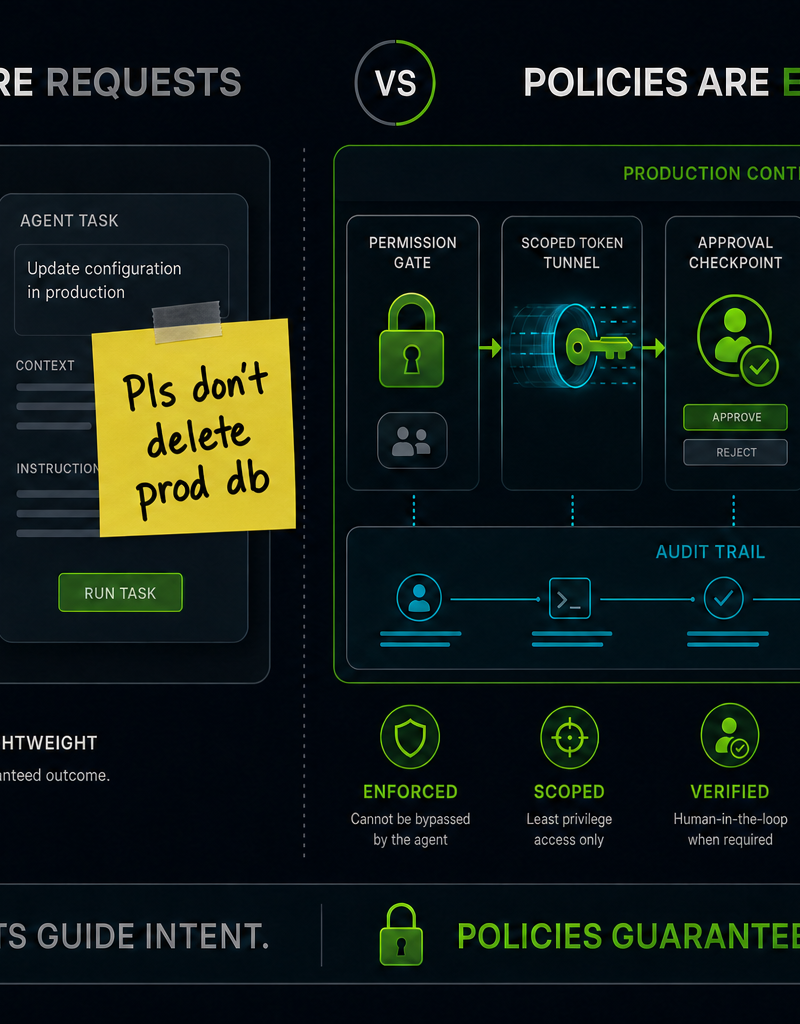
Enterprises making the most of AI right now have spent the last decade doing work that rarely makes headlines: cleaning up pipelines, building self-service infrastructure that's secure by default, establishing clear ownership over their systems and data. AI didn't transform those organizations. It rewarded them.
Every few months, a new model drops. Every few weeks, a new framework. And every day, enterprise teams get pulled into another proof-of-concept that looks brilliant in a demo and disintegrates by Friday.
We've sat in enough architecture reviews to know exactly when a team is about to get humbled by their own pipeline, and we keep seeing the same pattern: the teams that are getting durable, measurable results from AI aren't the ones with the best prompts or the most expensive models. They're the ones who could answer "yes" to a short but brutal list of questions before they ever wrote a single AI integration. They also had fast, secure access to try new tools without a procurement or security process standing in the way.
THE PREREQUISITE NOBODY TALKS ABOUT
Spend any time in an enterprise AI discussion, and you'll hear about agents, RAG pipelines, fine-tuning, and governance frameworks. What you won't hear about, at least not until it's too late, is CI/CD and operating in production.
That's not a coincidence; platform fundamentals are boring, we all know that. They don't make for good conference talks or compelling vendor decks, but they are the load-bearing wall behind every AI use case that actually ships.
Consider what AI-powered development actually requires at scale: fast, reliable feedback loops so developers know whether their AI-assisted changes are safe to ship. Governed artifact repositories to ensure models and modules don't become another class of unmanaged dependencies. Identity infrastructure so you can actually answer who or what made a given call to a given system. Deployment mechanisms that can handle the unpredictable cadences introduced by agentic workflows.
This is all foundational. And the brutal truth is: if you didn't have it before you started layering in AI, you don't have a foundation. You have a complicated pile of things that mostly work.
WHAT "AI-READY" ACTUALLY MEANS
The phrase gets thrown around in pitches and roadmap reviews, but it rarely gets defined. Here's what we mean when we say an enterprise is genuinely AI-ready, not aspirationally, but operationally.
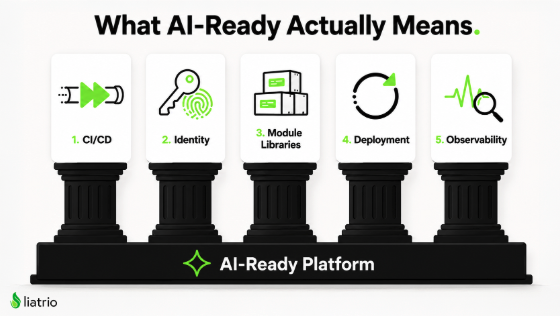
CI/CD is clean and fast.
Builds complete in minutes, not hours. Flaky tests have been evicted. The pipeline is a trusted signal, not a noise source. Teams have agency and the tools available on demand to build new solutions. AI-generated code needs the same gates as human-written code; you can't have one without the other.
Identity is real. Not "we have SSO."
Real: every service has an identity, every call is attributable, every policy is machine-enforced. When an AI agent makes a request on behalf of a user, can you answer who authorized it and when? If not, you don't have identity; you have access management theater and blind trust in AI acting on your behalf.
Module libraries are vendored.
Internal platforms, shared modules, and infrastructure components have owners, versioning, and automated change policies. Ungoverned libraries are the fastest way to turn AI acceleration into AI entropy and a security risk scenario no one wants.
Deployment is boring.
Boring in the best sense: reliable, scripted, auditable, and not dependent on one person who knows the trick. Agentic workflows deploy constantly and unpredictably. Your deployment mechanism needs to be ready for that before the agents are. Only then can you start to pull AI into your production deployment flow.
Observability is genuine.
You have logs, traces, and metrics you actually trust and look at. Not dashboards nobody opens. Not alerts that cry wolf. Real observability so that when something goes wrong in an AI workflow, and it will, you can find it.
That list isn't exhaustive, but it's a good first filter. If you can answer yes to all five, AI investment is likely to compound. If you can't, AI investment is likely to expose the gaps faster than it fills them.
THE DECADE THAT WASN'T WASTED
Liatrio spent a decade doing platform engineering when it wasn't fashionable. When DevOps was a buzzword and "platform team" mostly meant "the people who manage the Jenkins server," we were working inside enterprises to build the real thing: internal developer platforms that reduced cognitive load, golden paths that encoded organizational knowledge, CI/CD pipelines that were genuinely trusted, and enablement programs that changed how engineering teams actually worked, and not just what tools they used.
That work wasn't glamorous, and it wasn't fast. We were in the weeds alongside our clients, making the mistakes, hitting the dead ends, and figuring out which 20% of the work moves 80% of the needle. That accumulated pattern recognition is what lets the timeline compress now. The decade wasn't the prerequisite; it was the education. We're not asking anyone to repeat it.
That work looked like an infrastructure investment. It wasn't. It was organizational architecture. The platform was never really about the pipeline; it was about creating the conditions under which software teams could move fast with confidence, and for individual engineers to focus on outcomes rather than overhead.
In 2015, nobody was calling it AI readiness, but the work was the same. Looking back, it's hard to imagine what the alternative would have been. The organizations that skipped that work are the ones now discovering that bolting AI onto a fragile platform doesn't give you AI capability; it gives you AI-shaped fragility.
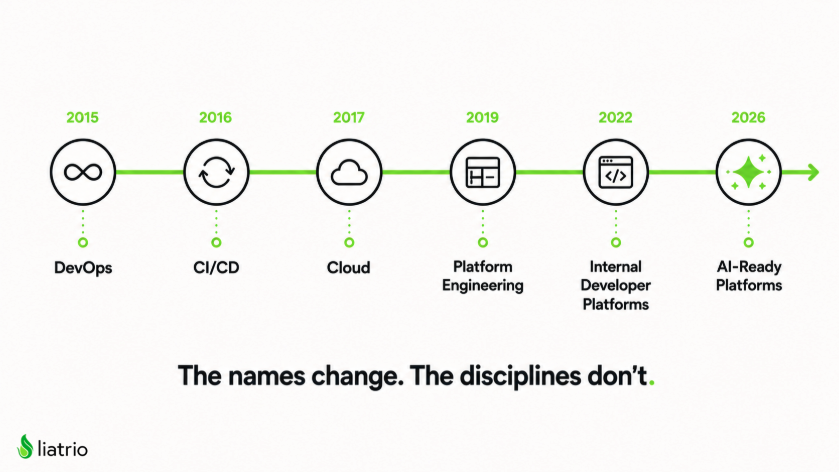
The same principles that made a well-run internal developer platform effective in 2018 are what make an agentic AI platform effective in 2026. The names change. The disciplines don't. Systems thinking, feedback loops, ownership models, automated governance: these aren't legacy ideas. They're the prerequisites.
AMPLIFICATION, NOT TRANSFORMATION
The word we keep coming back to is amplification. AI amplifies what's already there. If what's already there is a well-built platform, fast feedback loops, and teams that trust their tooling, AI dramatically multiplies the output of that system. Engineers ship more, iterate faster, and spend more time on problems that require human judgment.
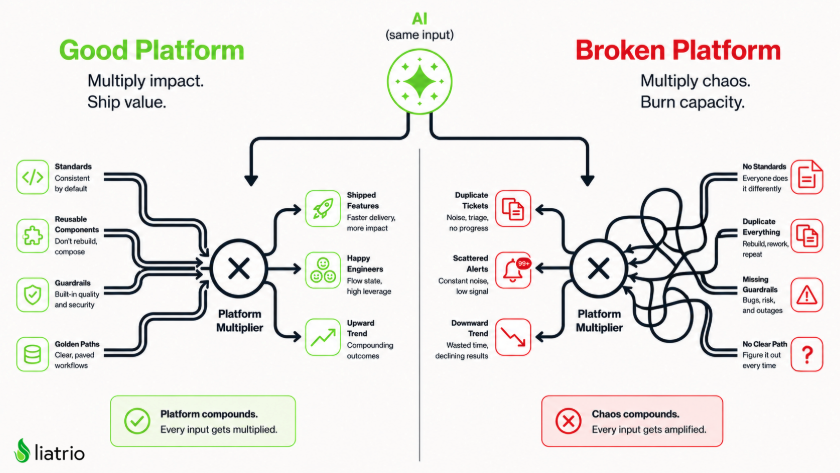
If what's already there is inconsistent pipelines, unclear ownership, and technical debt that's been deferred for 3 years because there was never a good time to address it, AI amplifies that too. It accelerates the generation of code that can't be shipped with confidence. It adds velocity to a system that was already moving in uncertain directions. It introduces agentic workflows into environments where the humans weren't even sure who owned what. It multiplies the volume of changes that no one has the confidence to actually ship.
This is why AI pilots that looked so promising in February become cautionary tales by June. The foundation was never there, and AI just found the cracks faster than anyone expected.
You can't fix a broken platform by layering AI on top of it. Fix the platform first, and suddenly, AI becomes the best investment you've ever made.
The good news is that "fix the platform first" is not a years-long prerequisite. Done right, it's targeted, intentional work that quickly unlocks AI investment. Every time Liatrio has helped enterprises go from fragmented, ticket-driven, top-down-mandated platforms to genuinely AI-ready platforms, the results from leveraging AI have followed. We have helped organizations make this change in months, not years, because we've been doing this long enough to know where the leverage is.
WHAT THIS MEANS FOR YOUR AI STRATEGY
If you're in a room where people are debating which AI vendors to standardize on, which tools and skills to leverage, what harnesses to use, how to build the enterprise AI Community of Practice, or how to set up AI Governance in a way that doesn’t stifle engineers, those are the real questions. But they're downstream questions. The upstream question is simpler and harder: does your platform deserve to be amplified?
One practical implication worth noting: don't standardize on a single model provider. I've watched organizations run their AI vendor selection the same way they'd procure enterprise software; one winner, one contract, locked in. The problem is that model capabilities are shifting faster than procurement cycles. The best model for code generation today may not be the best one in eight months. What your engineers actually need is broad, governed access to the current frontier with the same security and identity controls you'd apply to any other production dependency. Standardization in a market this dynamic isn't risk management. It's just a slower way to fall behind.
In five years, winning in AI will require something different from enterprises. The headline will no longer be focused on who placed the best bets on which models. It will come down to who built the organizational and technical conditions under which AI investment actually compounds - clean platforms built for and with engineers, genuine automated governance, enablement that changes how people work, and the space to learn and experiment. Not just what tools they have access to.
That's the work Liatrio has been doing for a decade. And it turns out to be exactly the work that makes AI effective.

The ceiling on what AI can do for your organization isn't set by the models. It's set by your platform. Build it well, and there's no ceiling. Build it poorly, and the most powerful technology lever we've ever had becomes one more thing that didn't quite deliver.