
THE CHALLENGE
Delivery ran on aging Jenkins pipelines. For one core application team, every production deployment meant manually SSHing into production servers. Migration to a modern platform had stalled at zero to one app per sprint, and a large portfolio had to move before a firm milestone.
WHAT WE DID — AND WHAT IT BROUGHT
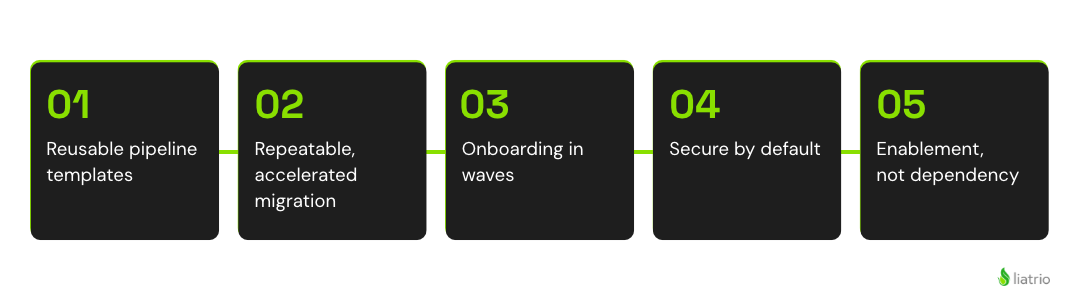
Reusable pipeline templates — Every application now follows the same secure, repeatable path to production on GitHub Actions.
Repeatable, accelerated migration — A migration tool and GitHub Copilot turned one-off rewrites into a repeatable, accelerated process. Internally, Liatrio's team used Claude and Claude Cowork, including scheduled weekly work-stream summaries, to help set up the move to spec-driven development with the client's engineers.
Onboarding in waves — Teams moved together instead of one app at a time, keeping momentum across the portfolio.
Secure by default — Manual SSH access to production servers for deployments is gone. New GitHub Actions workflows deploy automatically, with less risk and no manual steps.
Enablement, not dependency — Client engineers now own the model and deploy on their own through self-service pipelines.
THE RESULTS
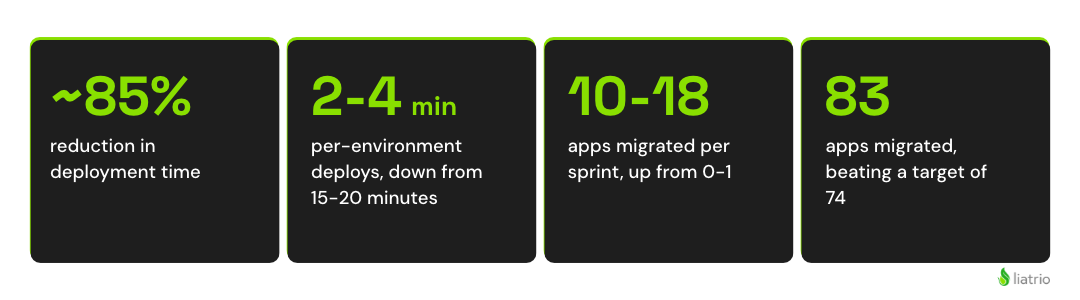
83 applications migrated to reusable GitHub Actions pipelines, beating a target of 74
One team had 13 of 13 apps live in production by Week 7, against a Week 10 target
Static code analysis now live across 70+ applications
WHAT’S NEXT
With 83 apps already migrated, the company is positioned to move 80%+ of its application portfolio onto the new platform by year-end, with self-service delivery as the default for new applications.